



Buying a new mattress usually comes down to one question sooner or later: memory foam or hybrid? Both types dominate the market, both promise pressure relief and better sleep, and both look pretty similar in online photos. Lie down on them, though, and they feel completely different.
The short version: memory foam hugs your body and absorbs movement, which makes it great for side sleepers and couples who wake each other up. Hybrids pair foam with a coil base, so they sleep cooler, feel bouncier, and hold up better for heavier bodies and stomach or back sleepers.
Neither one is “better” across the board. The right pick depends on how you sleep, how warm you run at night, who shares your bed, and what you’re willing to spend. Here’s how the memory foam vs hybrid decision actually plays out in 2026.
What Is a Memory Foam Mattress?
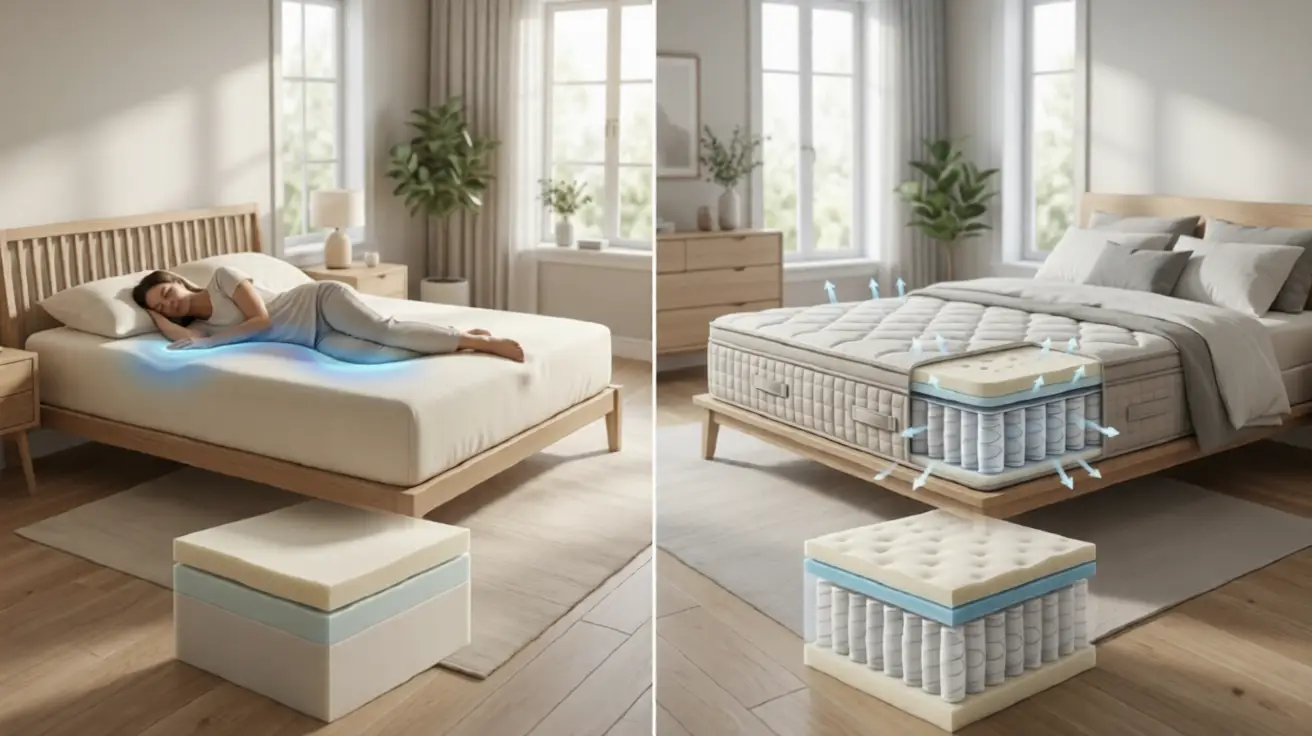
A memory foam mattress is built entirely from foam. The top layers use viscoelastic foam, a material that softens when it meets your body heat and pressure, then slowly molds around your shape. Underneath sit denser polyfoam layers that provide the actual support.
That slow, sinking hug is the signature memory foam feel. Your shoulders and hips press in, the foam fills the gaps around your waist and lower back, and your weight spreads out evenly across the surface. Pressure points fade, which is why so many side sleepers swear by it.
The same qualities create memory foam’s known weaknesses. Dense foam holds heat, and while gel infusions, copper infusions, and open-cell designs have improved cooling in recent years, all-foam beds still sleep warmer than coil-based ones. Foam also responds slowly, so changing positions can feel like working against the mattress. And the edges tend to compress when you sit or sleep near them.
What Is a Hybrid Mattress?
A hybrid mattress combines two technologies in one bed: foam comfort layers on top and a steel coil support core underneath. A typical build looks like this:
- Comfort layer (2 to 4 inches): memory foam, latex, polyfoam, or a mix
- Transition layer: medium-density foam that keeps you from feeling the coils
- Pocketed coil core: individually wrapped springs that move independently
- Reinforced perimeter: firmer coils or foam rails around the edge
The coils are what change everything. They add bounce, push back against your body instead of just cradling it, and leave open space inside the mattress for air to move through. That’s why hybrids consistently sleep cooler and feel more responsive than all-foam beds.
One thing worth knowing: “hybrid” only tells you the construction, not the feel. A hybrid topped with memory foam feels very different from one topped with latex. Coil gauge, coil count, and foam thickness all shift the firmness and character of the bed, so two hybrids at the same price can feel nothing alike.
Memory Foam vs Hybrid: Side-by-Side Comparison
| Feature | Memory Foam | Hybrid |
| Feel | Deep, slow-moving body hug | Buoyant, lifted, more responsive |
| Pressure relief | Excellent, especially for side sleepers | Good, depends on comfort layer |
| Motion isolation | Best in class | Good with pocketed coils, but foam wins |
| Cooling | Runs warmer, even with gel foams | Noticeably cooler thanks to coil airflow |
| Edge support | Weak to moderate | Strong, especially with reinforced perimeters |
| Bounce | Minimal | Moderate to high |
| Durability | Around 7 to 8 years for quality models | Around 8 to 10 years, often longer |
| Best for body weight | Under roughly 230 lbs | All weights, including 230 lbs and up |
| Typical queen price | $300 to $1,500 | $800 to $2,500+ |
| Weight of the bed | Lighter, easier to move | Heavy, harder to rotate and move |
The Key Differences That Actually Matter
Feel and Responsiveness
This is the difference you notice in the first ten seconds. Memory foam lets you sink in slowly and holds you there. Some people find that cradled feeling incredibly comfortable. Others describe it as feeling stuck, especially when rolling over at 3 a.m.
Hybrids feel more like a traditional bed. You sleep more on top of the surface than inside it, and the coils spring back quickly when you shift. Combination sleepers who change positions through the night usually find hybrids much easier to move on.
Temperature
If you sleep hot, this section probably decides it for you. Coils leave most of a hybrid’s interior as open air space, so body heat escapes instead of building up around you. Solid foam can’t match that, no matter how much cooling gel gets mixed in. Modern memory foam sleeps cooler than it did a decade ago, but in side-by-side testing, hybrids still come out ahead almost every time.
Motion Isolation
Here memory foam takes the win, and it isn’t close. Viscoelastic foam absorbs movement within inches, so a partner tossing, turning, or getting up early barely registers on your side of the bed. Hybrids with individually wrapped coils do a respectable job, but some movement still travels through the coil grid. Light sleepers sharing a bed will feel the difference.
Support and Spinal Alignment
Both types can support your spine well when the firmness matches your body and sleep position. The difference shows up over time and under weight. Steel coils push back with consistent force year after year, while foam gradually softens and can develop body impressions where you sleep. Sleepers over about 230 lbs, back sleepers, and anyone with back pain that feels worse after soft surfaces will generally do better on a hybrid’s firmer, more structured support.
Edge Support
Sit on the edge of an all-foam bed and you’ll feel it compress under you. Hybrids with reinforced perimeters stay firm right to the border, which matters more than people expect. Strong edges mean you can use the full width of the mattress, and they make getting in and out of bed easier, especially for older sleepers or anyone with mobility issues.
Durability
A quality memory foam mattress typically lasts 7 to 8 years before softening and sagging set in. A well-built hybrid usually delivers 8 to 10 years, sometimes more, because tempered steel coils resist breaking down far longer than foam. Heavier sleepers widen that gap, since extra weight accelerates foam compression. Warranties reflect this too, with many hybrid brands backing their beds for 10 to 15 years.
Price
Memory foam wins on entry price. Decent all-foam queens start around $300 to $500, with premium models running $1,000 to $1,500. Hybrids cost more to build because of the coil systems, so expect $800 to $2,500 for a quality queen, with luxury models going higher.
Factor in lifespan, though, and the math tightens up. A hybrid that costs 40% more but lasts two or three years longer can end up cheaper per year of use.
Which Should You Choose? Match It to How You Sleep
Choose Memory Foam If You…
- Sleep on your side. Your shoulders and hips carry most of your weight in this position, and foam’s deep contouring relieves that pressure better than coils.
- Share a bed with a restless partner. Nothing kills motion transfer like memory foam. If one of you works nights or wakes at 5 a.m., this alone can justify the choice.
- Have achy joints or pressure sensitivity. The even weight distribution takes stress off hips, shoulders, and knees.
- Are shopping on a tighter budget. Good memory foam simply costs less at every quality tier.
- Weigh under roughly 230 lbs. Foam supports lighter and average bodies well, and durability concerns shrink at lower weights.
Choose a Hybrid If You…
- Sleep hot. The airflow through the coil core makes a real, measurable difference on warm nights.
- Sleep on your back or stomach. These positions need firmer, more structured support to keep your hips from sinking and your spine aligned.
- Weigh over 230 lbs. Coils provide deeper, more durable support than foam cores, and the bed will hold its shape years longer.
- Change positions during the night. The responsive surface makes rolling over effortless instead of a wrestling match.
- Want the longest-lasting bed. Steel coils outlive foam. If you’re buying for the next decade, hybrids age better.
- Use the edge of the bed a lot. Whether for sitting, reading, or sharing a smaller mattress, reinforced edges expand your usable space.
Still Torn? A Middle Path
A hybrid with a thick memory foam comfort layer gets you most of the foam hug plus coil support and cooling. It’s the most popular hybrid configuration in 2026 for exactly that reason. If you love the memory foam feel but worry about heat or durability, this build is the natural compromise.
What About Couples?
Couples usually juggle three competing needs: motion isolation, edge support, and temperature. Memory foam wins the first, hybrids win the other two.
The practical answer for most couples is a hybrid with pocketed coils, since individually wrapped springs contain movement reasonably well while the coils handle cooling and edge support. But if one partner is a genuinely light sleeper and the other tosses all night, memory foam’s stillness may matter more than everything else combined.
Frequently Asked Questions
Is a hybrid mattress better than memory foam?
Neither is better overall. Hybrids outperform memory foam on cooling, bounce, edge support, and durability, while memory foam wins on motion isolation, pressure relief, and price. The better mattress is the one that matches your sleep position, body weight, and temperature needs.
Which lasts longer, memory foam or hybrid?
Hybrids generally last longer. A quality hybrid delivers around 8 to 10 years of use because steel coils resist sagging, while memory foam typically softens noticeably after 7 to 8 years. The gap widens for sleepers over 230 lbs.
Do hybrid mattresses sleep cooler than memory foam?
Yes. The coil core leaves open space for air to circulate, which pulls heat away from your body. Gel-infused and open-cell memory foams have narrowed the gap, but hybrids still sleep measurably cooler in testing.
Is memory foam or hybrid better for back pain?
It depends on your symptoms. Deep contouring foam helps when pain comes from pressure points, which is common for side sleepers. If your back feels better standing or walking than sitting, a firmer hybrid with structured coil support is usually the smarter pick. When in doubt, medium-firm is the safest starting point for most people with back pain.
Is memory foam or hybrid better for side sleepers?
Memory foam is usually the better fit for side sleepers because it cushions the shoulders and hips where pressure concentrates. That said, a softer hybrid with a memory foam comfort layer can work well too, especially for side sleepers who run hot.
How much should I spend on a memory foam or hybrid mattress?
For a queen, plan on $500 to $1,200 for a quality memory foam mattress and $1,000 to $2,000 for a solid hybrid. Cheaper options exist in both categories, but very low-priced beds often use thin foams and light coils that wear out fast.
The Bottom Line
The memory foam vs hybrid question really comes down to a trade. Memory foam gives you the deepest pressure relief and the quietest, most motion-free sleep surface at a lower price. Hybrids give you cooler sleep, easier movement, sturdier edges, and a bed that lasts several years longer.
If you’re a side sleeper, a light sleeper sharing a bed, or shopping on a budget, memory foam earns its keep. If you sleep hot, sleep on your back or stomach, weigh over 230 lbs, or just want the longest-lasting mattress, a hybrid is the safer bet. And if you can, spend fifteen minutes lying on both in a showroom. The difference in feel is obvious within minutes, and no comparison chart replaces your own back telling you what it likes.