






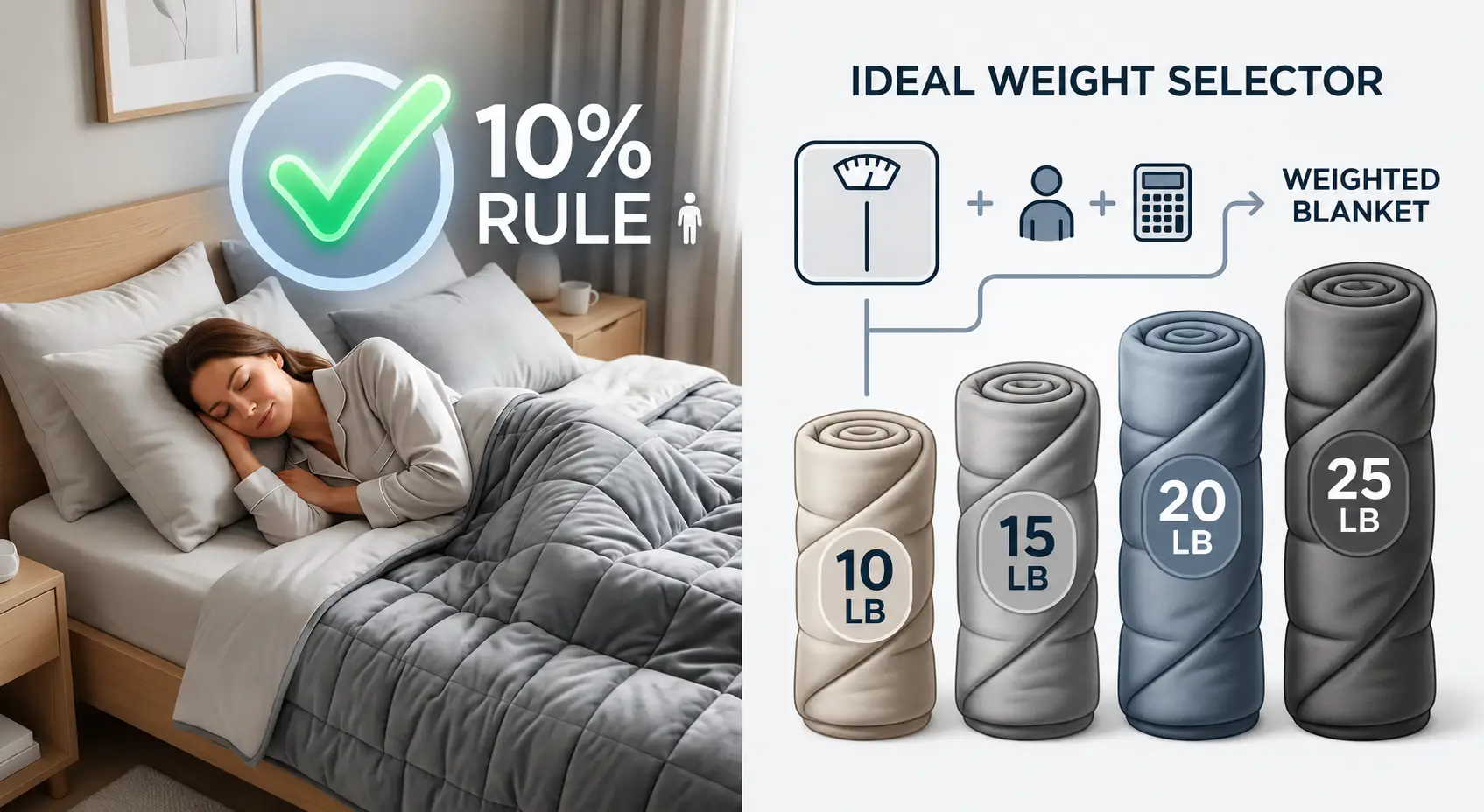
Buying a weighted blanket sounds simple until you see the options. Twelve pounds, fifteen, twenty, twenty-five. Pick wrong and you either get a blanket that feels like nothing or one that pins you to the mattress at 2 a.m.
The good news is that there’s a reliable starting point, and it fits in one sentence: your weighted blanket should weigh about 10% of your body weight. That’s the 10% rule. But it’s a starting point, not a law, and knowing when to bend it matters just as much as knowing the rule itself.
Here’s how it works, when to go lighter or heavier, and what the safe limits are for kids.
What the 10% Rule Actually Means
Take your body weight, move the decimal one place to the left, and that’s your target blanket weight.
- Weigh 150 lbs? Start with a 15 lb blanket.
- Weigh 200 lbs? Look at 20 lbs.
- Weigh 120 lbs? A 12 lb blanket is your baseline.
The logic behind the number comes down to pressure. Weighted blankets work through something called deep pressure stimulation, a firm but gentle sensation across the body that feels a bit like being held. Too little weight and you barely notice it’s there. Too much and the pressure stops being calming and starts feeling restrictive. Ten percent tends to land in the sweet spot for most people.
You don’t need to hit the number exactly. Preferred weights vary between 5% and 12% of body weight, with most people settling around 10%. If your ideal number falls between two available sizes, many experts suggest rounding up by one to two pounds rather than down, since a blanket that’s slightly too light often fails to deliver the effect people buy it for.
Weighted Blanket Weight Chart
Use this as a quick reference. All weights are approximate, and personal comfort should get the final vote.
| Your Body Weight | Suggested Blanket Weight |
| 100 lbs | 10 lbs |
| 120 lbs | 12 lbs |
| 140 lbs | 14 to 15 lbs |
| 160 lbs | 15 to 17 lbs |
| 180 lbs | 18 to 20 lbs |
| 200 lbs | 20 to 22 lbs |
| 220 lbs | 22 to 25 lbs |
| 250 lbs+ | 25 to 30 lbs |
Most brands sell blankets in set increments like 10, 15, 20, and 25 pounds, so you’ll usually be choosing the closest match rather than an exact figure.
When to Go Lighter Than 10%
The rule assumes an average healthy adult with no strong preferences. Plenty of people don’t fit that picture, and going lighter makes sense if:
You’re new to weighted blankets. The sensation takes getting used to. A blanket at 7 to 8% of your body weight lets you adjust without feeling trapped. A blanket that’s too light won’t cause harm, it just won’t provide much benefit, which makes light the safer direction to err in.
You tend to feel claustrophobic. Weighted blankets may not suit sleepers who feel claustrophobic under pressure, and if you still want to try one, a lighter weight lowers the odds it ends up in the closet.
You run hot at night. Heavier blankets usually mean more fill, and more fill traps more heat. Dropping a few pounds (and choosing a breathable cover) helps.
You’re an older adult or have limited strength. You should be able to push the blanket off easily from any sleeping position. If lifting it feels like effort while standing, it’s too heavy for sleeping under.
When Heavier Might Work Better
Some people genuinely prefer more pressure, and that’s fine within reason. Some occupational therapists recommend going up toward 15 or even 20 percent of body weight for people with higher anxiety or sensory-seeking needs, since comfort matters more than a formula.
Sleeping position plays a role too. Side sleepers often benefit from a heavier weight because the added heft keeps the blanket snug against the body, while back sleepers usually do well at or below the standard 10%.
There’s a ceiling, though. Going past 15% of body weight can feel oppressive and restrict movement during sleep. The simple test: if you can’t easily roll over, reposition, or slide out from under the blanket, it’s too heavy no matter what percentage it works out to.
Weighted Blankets for Kids: Extra Caution Required
This is where the 10% rule needs real modification, because the stakes are different.
First, the hard limits. Weighted blankets should never be used with infants, and pediatric safety guidance extends that caution to children under two, due to suffocation risk. Many brands and sleep experts push the minimum higher. Weighted blankets are generally considered appropriate for children aged 3 and older who weigh at least 50 pounds.
For kids who clear that bar, the common formula is 10% of the child’s body weight plus one to two pounds, so a 50 lb child would use a 5 to 7 lb blanket. In practice, lighter is usually smarter. Err on the lower end of the range, and check with your family doctor before buying, since the 10% rule doesn’t transfer neatly to children.
One test cuts through everything else: if your child cannot physically remove the blanket without help, they should not be using it.
Who Should Skip Weighted Blankets Entirely
Weight on the body isn’t neutral for everyone. Talk to a doctor first, or avoid weighted blankets altogether, if any of these apply:
- Sleep apnea or asthma. The added pressure on airways can make breathing harder during sleep, which is the opposite of what you want with a breathing disorder.
- Circulation problems or low blood pressure. Sustained pressure can affect blood flow.
- Limited mobility. Anyone who can’t reliably remove the blanket on their own shouldn’t sleep under one unsupervised.
For people in these groups who still want the calming effect, a weighted lap pad or weighted pillow can offer similar pressure without weight across the chest.
Quick Answer: What Weight Should You Get?
For a 40 to 60 word snippet-style answer: A weighted blanket should weigh roughly 10% of your body weight. A 150 lb adult would choose a 15 lb blanket, and a 200 lb adult would choose 20 lbs. Comfort varies, so anywhere from 5% to 12% works. Kids need lighter blankets, medical clearance, and must be able to remove the blanket themselves.
FAQ
Is a 20 lb weighted blanket too heavy for me?
Depends on your size. At 200 lbs, it’s right on target. At 140 lbs, it’s roughly 14% of your body weight, which some people enjoy but many find restrictive. If you’re under about 160 lbs, try 15 lbs first.
Can two people share one weighted blanket?
You can, but it’s a compromise. A queen or king weighted blanket spreads its weight across a larger area, so each person feels less pressure. Couples with different body weights often do better with two individual blankets, which also ends the nightly blanket tug-of-war.
Should I size up or down if I’m between weights?
For adults, size up by one to two pounds if you’re between options. For children, always size down and confirm with a pediatrician.
Is it OK to sleep under a weighted blanket all night?
For healthy adults, yes. If you wake up feeling sore, overheated, or like you fought the blanket all night, drop to a lighter weight.
Do weighted blankets lose effectiveness over time?
The blanket doesn’t change, but your body adapts to the sensation. Some long-term users eventually move up a few pounds. Start at 10% regardless; you can always adjust later.
What about blanket size, not just weight? Match the blanket to your body, not your bed. A weighted blanket should cover you without hanging over the mattress edges, since overhang lets gravity slowly drag it off the bed overnight.
The Bottom Line
Start at 10% of your body weight. Round up a pound or two if you’re between sizes, go lighter if you’re new to weighted blankets or run hot, and never exceed a weight you can easily throw off. For kids, stay conservative, wait until at least age 3, and ask your pediatrician first. The formula gets you close; how the blanket feels after a week of real sleep tells you whether you got it right.