

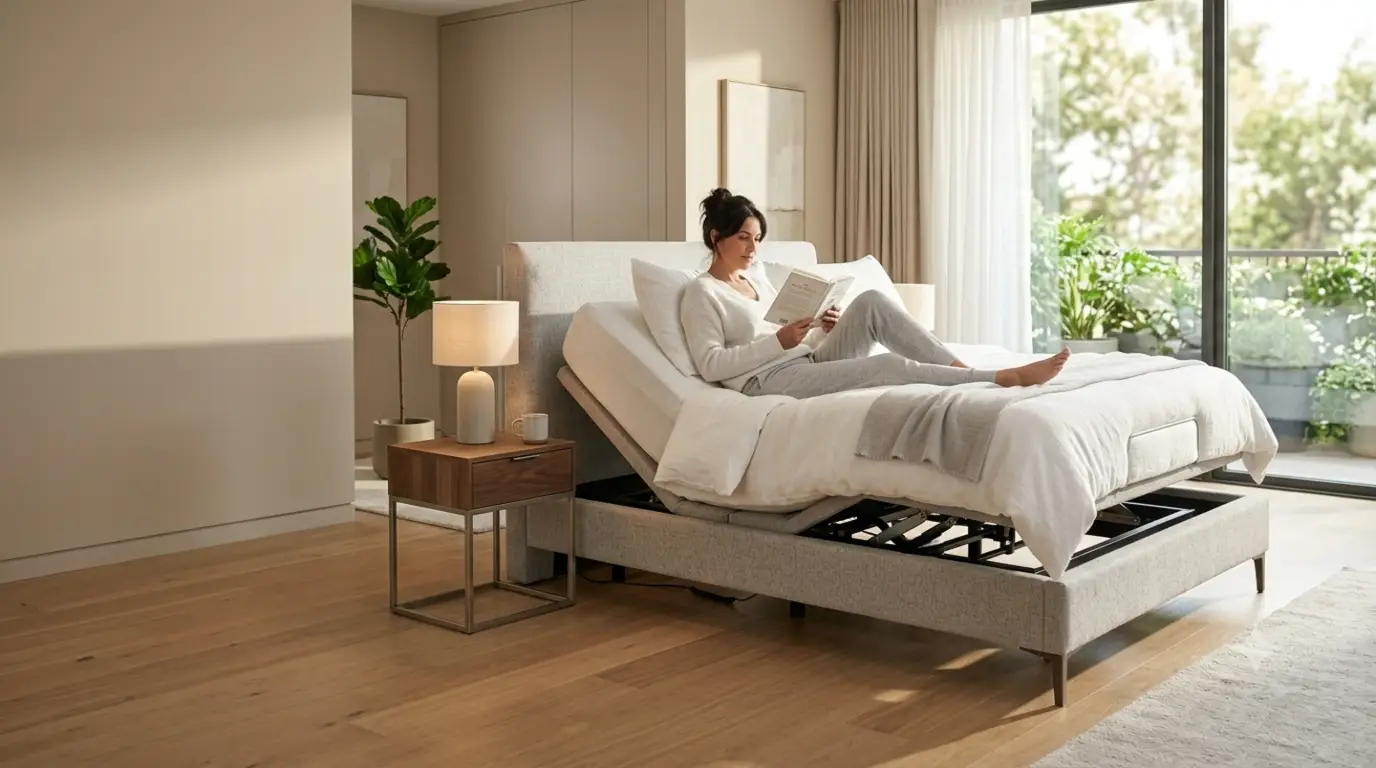
An adjustable bed base sounds like a luxury until you actually sleep on one. Then it starts to feel like the thing your bed was missing all along. You can raise your head to read or stop snoring, lift your legs after a long day, or settle into that weightless zero-gravity position everyone keeps talking about.
The catch is the price. A decent queen base starts around $600, and premium models push past $2,500. That’s real money for something that sits under your mattress.
So here’s the honest breakdown: the best adjustable bed bases of 2026, what they actually cost, who genuinely benefits, and who’s better off keeping a flat frame and saving the cash.
What Is an Adjustable Bed Base?
An adjustable bed base is a motorized foundation that raises or lowers the head and foot sections of your mattress independently. Controlled by a remote or app, it replaces a standard frame or box spring and lets you sleep, read, or relax at custom angles instead of lying flat.
Most modern bases also pack in extras: preset positions, massage motors, USB charging ports, and under-bed lighting. They’ve moved well past the hospital-bed image. In fact, market research firm Grand View Research projects the US adjustable bed frame market will reach over $13 billion, which tells you how mainstream these have become.
The Best Adjustable Bed Bases of 2026
After comparing lab-tested reviews from Consumer Reports, AARP, Mattress Clarity, NCOA, and Mattress Nerd, along with real owner feedback, these six bases stand out.
1. Nectar Premier Adjustable Base — Best Overall
The Nectar Premier keeps landing at the top of independent tests for one simple reason: it does everything well. Testers consistently praise how quiet the motor is, even at steep angles, and the range of motion beats most rivals in its price class.
You get zero-gravity and anti-snore presets, a massage function, under-bed lighting, and USB ports on both sides. Nectar also offers something rare in this category: a 50-night trial with returns, so you can actually test it at home. White-glove delivery is available starting around $199 if you’d rather not assemble it yourself.
Price: Around $1,400 for a queen before discounts (Nectar runs promotions almost constantly, so you’ll rarely pay full price).
Pros:
- Near-silent motor with smooth transitions
- Anti-snore preset that genuinely helps light snorers
- Sleep trial with returns, which most brands skip
- Under-bed lighting for nighttime trips
Cons:
- Only a 3-year warranty, well below the 10-year industry standard
- The remote takes some getting used to
- Heavy boxes make solo assembly a chore
Best for: First-time buyers who want a safety net. The trial period removes most of the risk.
2. Saatva Adjustable Base Plus — Best for Seniors and Service
Saatva’s biggest advantage isn’t a feature on the base. It’s the free in-home setup. A delivery team assembles everything in your bedroom, which matters a lot if you have arthritis, a bad back, or simply no interest in wrestling a 150-pound frame.
The base itself is excellent too. Head and foot sections move independently, the legs adjust from 13 to 18 inches so you can set the right height for getting in and out of bed, and the remote has a built-in flashlight. The Plus model adds head and foot massage. It’s backed by a 10-year warranty, which is where it should be at this price.
Price: Roughly $1,250 to $1,800 for a queen depending on the model.
Pros:
- Free white-glove delivery and setup
- 10-year warranty
- Adjustable leg height, a small detail with big daily impact
- Simple, uncluttered controls
Cons:
- Fewer tech extras than similarly priced rivals
- No sleep trial on the base itself
Best for: Older adults, anyone with mobility limits, and buyers who value service and warranty over gadgets.
3. Helix Adjustable Base — Best Value
The Helix base packs in features that usually cost several hundred dollars more: a three-intensity massage function, zero-gravity preset, three programmable memory positions, and USB ports on each side. Mattress Nerd named it their top overall pick largely on that price-to-feature ratio.
The trade-off is the return policy. There isn’t one. Once it’s delivered, it’s yours.
Price: Typically $900 to $1,100 for a queen.
Pros:
- Massage, memory presets, and USB ports at a mid-range price
- Solid build quality for the money
Cons:
- No returns, full stop
- Assembly is heavy work and tough for one person
Best for: Confident buyers who’ve already tried an adjustable base and know they want one.
4. Brooklyn Bedding Ascension Power Base — Best Budget Pick
At around $600 for a queen and $1,200 for a split king, Brooklyn Bedding undercuts nearly everyone while keeping the features people actually use: zero gravity, TV mode, anti-snore, customizable presets, USB ports, and a cordless remote with a flashlight. Couples can even sync both halves of a split king to move together.
The warranty is short at 2 years, and you won’t get the whisper-quiet refinement of pricier motors. But as an entry point, nothing else comes close.
Price: About $600 for a queen, around $1,200 for a split king.
Pros:
- Cheapest full-featured base from a reputable brand
- Split king costs less than many single queen bases
- Free shipping
Cons:
- 2-year warranty
- Motor is audible, though not disruptive
Best for: Budget shoppers and couples who want a split king without a $3,000 bill.
5. DreamCloud Premier Adjustable Base — Easiest to Use
In AARP’s 2026 lab testing with older adults, the DreamCloud Premier earned the best all-around scores, and testers singled out the remote. Every function is labeled clearly, and the adjustments start and stop gradually instead of jerking you upright. One 62-year-old tester rated the remote’s design and ease of use a perfect score.
Price: Around $1,200 to $1,500 for a queen.
Pros:
- The most intuitive controls in this roundup
- Smooth, gradual motion that never feels jarring
- Supportive at every angle
Cons:
- Fewer flashy extras than Saatva or Tempur-Pedic
- Trial and warranty terms are middle of the pack
Best for: Anyone who wants a base their parents (or they themselves) can figure out in five minutes.
6. Tempur-Pedic Tempur-Ergo Smart Base — Best Premium Option
If money isn’t the deciding factor, the Tempur-Ergo line is where adjustable bases get genuinely smart. The ProSmart version tracks your sleep through the base itself, offers coaching through an app, and includes automatic snore response: it detects snoring and quietly raises your partner’s head without waking either of you.
Price: $1,500 to $2,800+ depending on size and version.
Pros:
- Automatic snore detection and response
- Sleep tracking without a wearable
- Excellent build quality and motor refinement
Cons:
- Expensive, and the smart features cost a steep premium
- Overkill if you just want head and foot adjustment
Best for: Tech-minded sleepers and couples where one partner snores heavily.
Quick Comparison
| Base | Queen Price (approx.) | Warranty | Trial/Returns | Standout Feature |
| Nectar Premier | $1,400 | 3 years | 50 nights | Best all-around performance |
| Saatva Adjustable Plus | $1,250–$1,800 | 10 years | No | Free in-home setup |
| Helix | $900–$1,100 | Limited | No returns | Feature-packed for the price |
| Brooklyn Bedding | $600 | 2 years | No | Lowest price |
| DreamCloud Premier | $1,200–$1,500 | Varies | Limited | Easiest controls |
| Tempur-Ergo Smart | $1,500–$2,800+ | 10 years (limited) | No | Auto snore response |
Prices shift often with sales, so treat these as ballpark figures before discounts.
So, Are Adjustable Bed Bases Worth the Price?
Honest answer: it depends entirely on why you want one.
Worth it if:
- You have acid reflux or GERD. Sleeping at a slight incline uses gravity to keep stomach acid down. A wedge pillow works, but a base holds the angle all night without sliding.
- You snore (or your partner does). Raising the head a few degrees helps keep the airway open. It won’t replace a CPAP for diagnosed sleep apnea, but for garden-variety snoring it makes a real difference.
- You have lower back pain. The zero-gravity position, with head and knees elevated, takes pressure off the lumbar spine. Physical therapists consulted in AARP’s testing pointed to this as one of the clearest benefits.
- You spend real time in bed awake. Reading, working, watching TV. Propping yourself on a pillow stack is a poor substitute for actual upright support.
- You have swelling or circulation issues. Elevating your legs above heart level helps fluid drain and can reduce morning numbness.
- You’re a couple with different needs. A split king lets one of you sleep flat while the other sits up, no negotiation required.
Skip it if:
- You sleep flat and fall asleep fast. If you’re out in ten minutes and never wake up with pain or reflux, a $1,200 base solves a problem you don’t have.
- Your mattress isn’t compatible. Traditional innerspring mattresses often can’t flex without damage. If you’re not replacing your mattress, check compatibility with the manufacturer first. Memory foam, latex, and most modern hybrids work fine.
- You’re a stomach sleeper. Almost none of the positions help you.
- The budget is tight. A great mattress on a flat frame beats a mediocre mattress on an adjustable base every time. Fix the mattress first.
One more cost note: think in terms of years, not sticker price. A well-built base lasts about 10 years. A $1,200 base works out to roughly $10 a month over its lifespan. Framed that way, it’s less than most streaming subscriptions, but only if you’ll actually use the adjustments.
What to Check Before You Buy
Mattress compatibility. This is the mistake that ruins the purchase. A mattress that isn’t designed to flex delivers a fraction of the benefit and can be damaged by the movement. Call your mattress manufacturer if you’re unsure.
Single, split, or split-head. A single base moves the whole mattress at once. A full split king uses two twin XL mattresses that adjust independently, though there’s a gap in the middle. A split-head design adjusts each sleeper’s upper body separately with no gap, but finding fitted sheets for it is a headache.
Warranty length. This varies wildly, from 2 years (Brooklyn Bedding) to 10 years (Saatva, Tempur-Pedic). Since you’re buying a motorized product you’ll use nightly for a decade, warranty terms deserve more weight than a massage feature you’ll use twice.
Trial period. Most brands don’t allow returns on adjustable bases. Nectar’s 50-night trial is a genuine outlier and worth factoring into your decision if you’re on the fence.
Noise and weight capacity. Cheaper motors hum louder, which matters if you adjust positions while a partner sleeps. And check the weight limit, which should cover the mattress plus both sleepers with margin to spare.
Delivery and setup. These bases weigh 100 to 200 pounds. If lifting that isn’t realistic, prioritize brands with free white-glove service (Saatva) or budget the extra fee (Nectar, around $199).
FAQ
How much does a good adjustable bed base cost?
Expect $600 to $1,100 for a solid queen base with core features, $1,200 to $1,500 for premium builds with better motors and warranties, and $1,500 to $2,800+ for smart bases with sleep tracking. Frequent sales mean you should rarely pay list price.
Will an adjustable base ruin my mattress?
Not if they’re compatible. Flexible mattresses like memory foam and latex handle the bending fine. Your mattress may show wear slightly faster than on a flat frame simply because it flexes nightly, but a compatible pairing won’t cause damage.
Do adjustable beds help with sleep apnea?
Elevating the head can reduce snoring and improve airflow, and many bases include anti-snore presets. But for diagnosed sleep apnea, a CPAP machine remains the recommended treatment. Treat the base as a supplement, not a replacement, and talk to your doctor first.
How long do adjustable bed bases last?
Around 10 years with normal use, which conveniently matches the typical lifespan of a mattress. Motor quality is the main variable, which is another reason warranty length matters.
Can I use my existing bed frame with an adjustable base?
Often, yes. Many bases fit inside a standard or decorative bed frame, as long as the interior dimensions match and the frame doesn’t block the moving sections. Measure before you buy.
Do I need a box spring with an adjustable base?
No. The base replaces the box spring entirely. Adding one would actually prevent the mattress from flexing.
Final Verdict
Adjustable bed bases earn their price for a specific group of people: anyone dealing with reflux, snoring, back pain, or circulation problems, and anyone who treats their bed as a place to live, not just sleep. For those buyers, the Nectar Premier is the safest starting point thanks to its trial period, Saatva is the pick for service and warranty, and Brooklyn Bedding proves you don’t need $1,500 to get the core experience.
If none of those situations describe you, keep your flat frame. Put the money toward a better mattress instead. That upgrade helps every sleeper. An adjustable base only helps the right one.